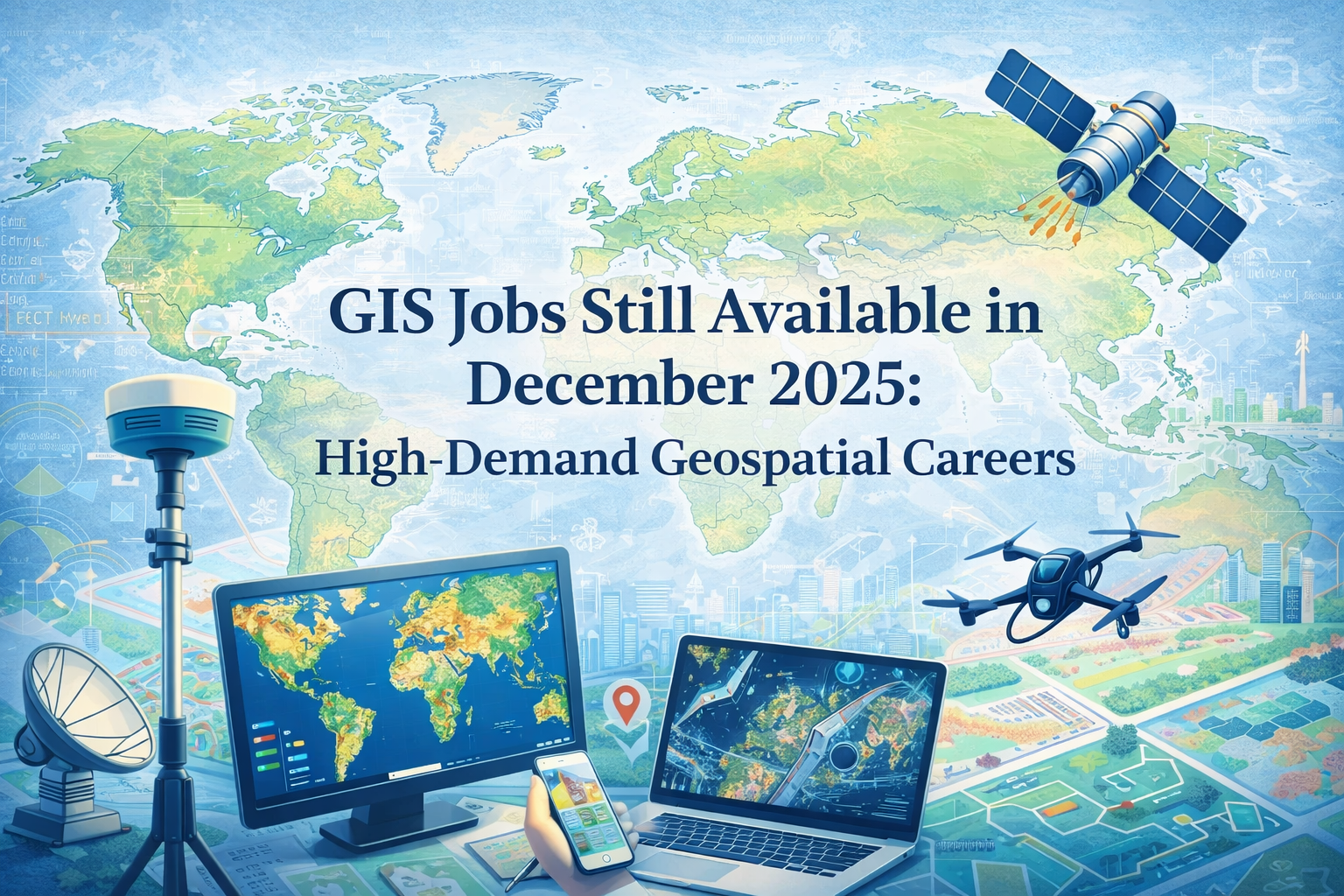
GIS Jobs Still Available in December 2025: High‑Demand Geospatial Careers

Introduction – GIS careers thrive in a rapidly evolving landscape
Geographic information systems (GIS) have moved from specialized mapping tools to a critical foundation for modern decision‑making. In late 2025 the geospatial job market continues to grow, with more than 32,000 job postings requiring GIS skills on major platforms and an average salary around US $75 k per yearbootcampgis.com. Demand spans government agencies, private firms and NGOs because GIS integrates location intelligence into fields as diverse as infrastructure renewal, public health, retail analytics, climate resilience and defencebootcampgis.com. A separate analysis by research.com notes that GIS analysts typically earn US $40 k–90 k and that demand for their expertise will grow about 9 % by 2026research.com.
Why does demand remain high despite talk of automation? Emerging technologies amplify, rather than replace, geospatial professionals. AI and machine‑learning tools automate repetitive tasks, such as classifying satellite images or generating buffer analyses, allowing staff to focus on higher‑level questionsgeospatialtraining.com. Local governments are using AI to fast‑track permitting and improve citizen servicesgeospatialtraining.com. Remote work is also reshaping hiring; the pandemic proved that GIS teams can be distributed, prompting managers to embrace remote and hybrid staffing models. A GIS jobs report emphasises that remote positions are becoming mainstream, allowing companies to hire talent without relocation costs and giving employees better work‑life balancebootcampgis.com.
At the same time, the geospatial analytics market is booming: valued at US $33 billion in 2024, it is projected to exceed US $55 billion by 2029global.nmsu.edu. A separate forecast expects the market to reach US $95.8 billion by 2025 and US $174 billion by 2030global.nmsu.edu. Technological trends such as AI‑driven geospatial analysis, Internet‑of‑Things (IoT) integration, cloud‑based GIS platforms, 3D digital twins, mobile GIS and blockchain are expanding the scope of geospatial worklightboxre.com. These trends create new roles in GeoAI, climate analytics, smart‑city planning, satellite data processing and spatial database administration. Despite AI’s encroachment, the geospatial workforce remains largely made up of highly educated professionals—geoscientists (median pay US $99,240), geographers (US $97,200) and cartographers (US $78,380)—and the emphasis on analytical thinking, communication and critical reasoning means humans will remain indispensableprojectgeospatial.org.
The following sections profile ten high‑demand GIS careers available in December 2025, outline their responsibilities, skills, education paths and salary ranges, and highlight where you can find opportunities.
| # | Platform Name | Job Focus | Coverage | Job Type | Link |
|---|---|---|---|---|---|
| 1 | GISjobs.com | GIS, Geomatics, Remote Sensing | Global | Full-time / Contract | https://www.gisjobs.com/ |
| 2 | MyGISJobs | GIS, Spatial Analysis, GeoAI | Global | Full-time / Remote | https://www.mygisjobs.com/ |
| 3 | GIS Jobs Clearinghouse (GJC) | GIS, Cartography, Surveying | Global | Full-time / Academic | https://www.gjc.org/ |
| 4 | Jobingis | GIS, Mapping, Drone, Surveying | Europe-focused | Full-time / Contract | https://www.jobingis.com/ |
| 5 | Indeed (GIS Jobs) | GIS, GeoAI, Remote Sensing | Global | Full-time / Remote / Hybrid | https://www.indeed.com/q-gis-jobs.html |
| 6 | FlexJobs | Remote GIS & Spatial Data Jobs | Global | Remote / Hybrid | https://www.flexjobs.com/remote-jobs/gis |
| 7 | Working Nomads | Remote GIS & Data Jobs | Global | Fully Remote | https://www.workingnomads.com/remote-gis-jobs |
| 8 | Virtual Vocations | Remote GIS & Mapping Jobs | Global | Remote | https://www.virtualvocations.com/q-remote-gis-jobs.html |
| 9 | Upwork | Freelance GIS Projects | Global | Freelance / Contract | https://www.upwork.com/freelance-jobs/gis/ |
| 10 | UNJobs (Geospatial Theme) | GIS for UN & NGOs | International | Contract / Full-time | https://unjobs.org/themes/geospatial |
| 11 | SEEK (AU / NZ) | GIS & Spatial Jobs | Australia / NZ | Full-time | https://www.seek.com.au/geospatial-jobs |
| 12 | JobStreet (SEA) | GIS, Surveying, Mapping | Southeast Asia | Full-time | https://www.jobstreet.com/geographic-information-system-gis-jobs |
1. GIS Analyst
Job description: GIS analysts manage and analyse spatial data to support decision‑making across sectors such as urban planning, environmental management and transportation. They create maps, build databases and produce reports that turn raw geospatial data into actionable insightsresearch.com.
Key responsibilities
- Data collection and management: Gather geographic data from satellites, surveys or sensors and ensure accuracy and organisationresearch.com.
- Spatial analysis: Apply overlay, proximity and network analyses to identify patterns and forecast scenariosresearch.com.
- Map production and visualisation: Use cartographic principles to design static and interactive maps for decision‑makersresearch.com.
- Database maintenance: Update and maintain GIS databases, ensuring data integrity and securityresearch.com.
- Collaboration: Work with engineers, planners and executives to communicate spatial insightsresearch.com.
Required skills & tools: Proficiency with ArcGIS Pro, QGIS, PostGIS, Python (e.g., GeoPandas, rasterio), SQL, geostatistical methods and data‑visualisation tools. Employers increasingly seek familiarity with cloud‑based platforms (ArcGIS Online, AWS, Azure) and AI frameworks for automated classification and predictive modellinglightboxre.com.
Education / certifications: A bachelor’s degree in geography, environmental science or GIS is typical. Certifications like GIS Professional (GISP) or Esri’s ArcGIS Online Developer series can boost prospects. Research.com notes that most GIS analysts hold a bachelor’s degree and benefit from Python proficiencyresearch.com.
Experience level: Entry to senior. Analysts may start as technicians and progress to senior GIS analyst or project manager roles.
Industries hiring: Government agencies (city planning, transportation, natural resources), environmental consultancies, utilities, real estate, logistics and marketingbootcampgis.com.
Expected salary range (global average): US $40,000–90,000 with strong job growth (about 9 % by 2026)research.com.
Remote/on‑site/hybrid: Many GIS analyst roles are hybrid or fully remote thanks to cloud‑based tools and remote data accessbootcampgis.com. Fieldwork may be required for data collection.
2. GIS Developer / Geospatial Software Developer
Job description: GIS developers design, build and maintain software that enables spatial analysis and mapping. They develop custom tools, automate workflows and integrate geospatial functionality into enterprise systemsglobal.nmsu.edu.
Key responsibilities
- Application development: Build web or desktop mapping applications using frameworks such as ArcGIS API for JavaScript, Leaflet, OpenLayers and Mapbox GL.
- Database integration: Design spatial databases, implement PostGIS or Oracle Spatial schemas, and write efficient queries using SQLglobal.nmsu.edu.
- API design: Develop RESTful services that expose geospatial functions to other applications.
- Automation & scripting: Create Python or JavaScript scripts to automate data processing and analysis.
- UI/UX design: Build user‑friendly interfaces for non‑technical users.global.nmsu.edu.
Required skills & tools: Programming languages (Python, JavaScript, SQL, C++), GIS SDKs (Esri SDKs, QGIS plugins), cloud infrastructure (AWS, Azure), version control (Git) and containerisation. Knowledge of AI/ML libraries (scikit‑learn, TensorFlow) is increasingly valued.
Education / certifications: Bachelor’s or master’s in computer science, GIS or software engineering with geospatial courseworkglobal.nmsu.edu. Certifications like Esri’s Enterprise Geodata Management or cloud certificates (AWS Certified Developer) help.
Experience level: Mid to senior. Entry‑level opportunities exist for junior developers; senior positions oversee architecture and integration.
Industries hiring: Technology firms, logistics and supply chain companies, energy providers, government agencies and startups building location‑based servicesglobal.nmsu.edu.
Expected salary range: US $85,000–100,000+. GISGeography lists GIS developers among the high‑end salary careers (>US $80 k) with averages around US $85 kgisgeography.com, while NMSU notes an average salary of US $100,464global.nmsu.edu.
Remote/on‑site/hybrid: Many developer positions are fully remote or hybrid because code‑based work can be performed anywhere. Occasional on‑site meetings may be necessary.
3. GeoAI / Spatial Data Scientist
Job description: GeoAI professionals apply machine‑learning and deep‑learning techniques to spatial data. They develop models that detect patterns in satellite imagery, predict climate risks or optimise urban infrastructure. According to the Top 10 GIS Technology Trends for 2025, AI‑powered tools can analyse imagery to detect urban sprawl, predict wildfire risks and monitor deforestationlightboxre.com. The growing importance of AI means GIS workers who understand data science enjoy higher salaries and job securitybootcampgis.com.
Key responsibilities
- Model development: Train and deploy machine‑learning models for classification, regression and clustering using spatial data.
- Image analysis: Use deep‑learning techniques to extract features from high‑resolution satellite or drone imagery (e.g., building footprints, road networks, vegetation types).
- Predictive analytics: Build predictive models for flood risk, traffic congestion or environmental change.
- Data engineering: Prepare large spatial datasets for training, including data cleaning, augmentation and labelling.
- Visualization & interpretation: Communicate findings through dashboards and reports.
Required skills & tools: Expertise in Python, R, scikit‑learn, TensorFlow, PyTorch, GeoPandas, Rasterio and Google Earth Engine. Strong statistics and linear algebra background. Familiarity with cloud compute (AWS SageMaker, Azure ML) and geospatial frameworks.
Education / certifications: Master’s in data science, GIS or machine learning is often preferred. Online courses or specialisations (e.g., GeoAI certificate) can boost credibility.
Experience level: Junior to senior. Many roles require several years of data‑science experience; entry‑level positions exist in research labs.
Industries hiring: Environmental monitoring, agriculture, smart‑city analytics, disaster management, insurance, logistics and defence.
Expected salary range: US $90,000–120,000+ depending on industry and location; data scientists usually command higher compensation than traditional GIS analysts. GISGeography notes that senior geospatial software engineers and developers earn between US $99 k and US $103 kgisgeography.com; data‑science expertise typically pushes salaries above this range.
Remote/on‑site/hybrid: Often remote or hybrid; computing tasks run on cloud platforms. Field data collection may be required for training data.
4. Remote Sensing Specialist
Job description: Remote sensing specialists analyse satellite images, aerial photographs and drone data to monitor land‑use change, agriculture, climate impacts and natural resources. Their work supports sectors like defence, environmental science and disaster managementglobal.nmsu.edu.
Key responsibilities
- Image processing: Use software such as ERDAS Imagine, ENVI and open‑source SNAP to process multispectral and radar data.
- Feature extraction: Classify land cover, detect vegetation indices and identify anomalies (e.g., urban expansion or deforestation).
- Sensor integration: Combine imagery from satellites (Sentinel, Landsat, MODIS) and drones with GIS data for comprehensive analyses.
- Quality assurance: Validate image outputs with ground truth data; collaborate with field crews.
Required skills & tools: Proficiency with remote‑sensing software, photogrammetry, LiDAR analysis, Python (rasterio, GDAL), and ability to integrate remote‑sensing products into GIS workflowsglobal.nmsu.edu.
Education / certifications: Bachelor’s or master’s in GIS, geography, environmental science or earth sciences with coursework in remote sensingglobal.nmsu.edu. Certifications like American Society for Photogrammetry and Remote Sensing (ASPRS) Certified Mapping Scientist are advantageous.
Experience level: Junior to senior. Entry‑level positions may focus on image classification; senior roles design satellite missions and algorithms.
Industries hiring: Defence, environmental monitoring, agriculture, forestry, climate research, energy and disaster‑relief agencies.
Expected salary range: Approximately US $100,593 on average, depending on industry and experienceglobal.nmsu.edu. GISGeography lists remote‑sensing analysts at about US $83,000gisgeography.com.
Remote/on‑site/hybrid: Mostly office or remote; occasional field verification may be required.
5. GNSS / Surveying Engineer (Geodetic Engineer)
Job description: GNSS (Global Navigation Satellite System) and surveying engineers perform high‑precision measurements for mapping, infrastructure and construction projects. They operate GNSS receivers, total stations and laser scanners to collect accurate spatial data and support geodetic control networks.
Key responsibilities
- Field surveying: Conduct ground‑based surveys using GNSS, terrestrial laser scanning and photogrammetry to establish control points and measure terrain.
- Data processing: Process raw GNSS signals, perform coordinate transformations and error corrections, and generate accurate spatial datasets.
- Quality control: Ensure measurement precision through network adjustment, baseline analysis and geodetic computations.
- Integration: Integrate survey data with GIS and CAD systems for engineering design and construction.
Required skills & tools: Expertise with GNSS instruments (Trimble, Leica), survey software (Trimble Business Center, Leica Infinity), coordinate geometry, geodetic datums, and GIS/CAD integration. Familiarity with robotics and automated total stations improves efficiency.
Education / certifications: Bachelor’s degree in geomatics, civil engineering, surveying or geodesy. Professional licensure (e.g., Professional Land Surveyor – PLS) or Certified Geomatics Specialist is often required.
Experience level: Mid to senior; entry‑level technicians assist licensed surveyors.
Industries hiring: Civil engineering firms, construction companies, utilities, transportation agencies, mapping companies and government land departments.
Expected salary range: Salary varies by region. GISGeography lists Geodetic engineers as high‑end GIS professionals with salaries around US $98,000gisgeography.com. Other sources show average pay around US $60,000comparably.com; compensation increases with licensure and expertise.
Remote/on‑site/hybrid: Primarily on‑site or field‑based for data collection. Data processing and reporting can be done remotely.
6. Urban GIS Planner (Urban & Regional Planner)
Job description: Urban planners use GIS to guide land use, transportation, housing and community development. They evaluate zoning laws, forecast population growth and recommend policies for sustainable urban growthglobal.nmsu.edu.
Key responsibilities
- Spatial planning: Analyse land‑use patterns, infrastructure needs and environmental constraints.
- Policy analysis: Interpret zoning regulations and land‑use law; propose ordinances and development strategies.
- Community engagement: Present plans to stakeholders and incorporate feedback.
- Modeling & forecasting: Use GIS to model population growth, traffic flows and resource demand.
Required skills & tools: Proficiency with planning GIS tools (ArcGIS Urban, CityEngine), spatial modelling, demographic analysis, and knowledge of planning lawglobal.nmsu.edu.
Education / certifications: Master’s degree in urban planning, civil engineering or GIS. Certification from the American Institute of Certified Planners (AICP) can enhance credentials.
Experience level: Mid to senior; entry‑level as planning technician or GIS planner.
Industries hiring: Municipal and regional governments, planning consultancies, transportation authorities, real‑estate developers and NGOs.
Expected salary range: The median salary for urban and regional planners is about US $83,720global.nmsu.edu. Salaries vary by city size and project complexity.
Remote/on‑site/hybrid: Mostly on‑site or hybrid to attend public meetings and site visits; some analysis can be done remotely.
7. Environmental / Climate GIS Analyst
Job description: Environmental scientists and climate analysts use GIS to assess ecological health, monitor pollution and model climate impacts. They track wildlife migration, model sea‑level rise and design conservation strategiesglobal.nmsu.edu.
Key responsibilities
- Ecological monitoring: Map habitats, biodiversity hotspots and species distribution.
- Climate modeling: Integrate spatial data with climate models to predict flood risk, heat‑island effects and wildfire hazards.
- Resource management: Guide conservation and resource‑management decisions for forests, watersheds or coastal zones.
- Policy & reporting: Prepare environmental impact assessments and communicate findings to policymakers and the public.
Required skills & tools: Proficiency with GIS and remote sensing, geostatistical software, climate datasets (e.g., ERA5, CMIP6), and environmental modelling tools (e.g., SWAT, HEC‑RAS). Strong understanding of environmental policy and ecologyglobal.nmsu.edu.
Education / certifications: Bachelor’s or master’s in environmental science, ecology or GISglobal.nmsu.edu. Certifications from the American Meteorological Society or Certified Floodplain Manager may be beneficial.
Experience level: Junior to senior; research positions may require PhDs.
Industries hiring: Environmental agencies, conservation NGOs, consulting firms, climate research institutions, agriculture and renewable energy.
Expected salary range: Median salary around US $80,060global.nmsu.edu; senior climate analysts in private industry may earn above US $100,000.
Remote/on‑site/hybrid: Hybrid; field sampling and remote-sensing validation require travel, while analysis can be remote.
8. Spatial Database Administrator (PostGIS/Geodatabase Admin)
Job description: Spatial database administrators design, implement and maintain databases that store and serve geospatial data. They ensure spatial data integrity, optimise query performance and manage security and backups.
Key responsibilities
- Database architecture: Design schemas for spatial datasets, implement PostGIS, Oracle Spatial or SQL Server Spatial databases.
- Performance tuning: Optimize spatial indexes and queries for large datasets, manage replication and caching.
- Data governance: Enforce data quality standards and metadata management; implement security policies.
- Integration: Connect databases to GIS servers (ArcGIS Enterprise, GeoServer) and applications.
Required skills & tools: Strong SQL skills; experience with PostGIS, Oracle Spatial, SQL Server, Spatialite; knowledge of database administration, backup and recovery; understanding of GIS data formats (shapefiles, GeoJSON) and ETL workflows. Cloud database experience (AWS RDS, Azure PostgreSQL) is increasingly important.
Education / certifications: Bachelor’s in computer science, GIS or information systems. Certifications such as PostgreSQL Certified Developer or Oracle Spatial Specialist are beneficial.
Experience level: Mid to senior; roles often require several years of database and GIS experience.
Industries hiring: Utilities, telecoms, transportation, government agencies and companies with large spatial datasets.
Expected salary range: US $80,000–100,000+. GISGeography lists GIS administrators among high‑end GIS salary positions (approx. US $96,000gisgeography.com).
Remote/on‑site/hybrid: Generally hybrid or remote since server administration can be done from anywhere; on‑site presence may be required for system integration.
9. Web GIS Developer
Job description: Web GIS developers build interactive mapping applications for browsers and mobile devices. Their applications enable public users or decision‑makers to visualise spatial data, perform analyses and interact with geospatial information online.
Key responsibilities
- Front‑end development: Use JavaScript frameworks (React, Vue) with mapping libraries (Leaflet, Mapbox GL JS, Esri’s ArcGIS API) to build responsive maps.
- Back‑end services: Develop APIs and geoprocessing services (e.g., using Node.js, Python Flask, GeoServer) to serve data to front‑end apps.
- Data integration: Consume and display data from open APIs, real‑time feeds and spatial databases.
- User experience: Design intuitive interfaces with features like search, layer control, geocoding and printing.
Required skills & tools: Proficiency in HTML, CSS, JavaScript, frameworks like React or Angular, mapping libraries, RESTful API design, cloud hosting and security best practices. Familiarity with ArcGIS Experience Builder and StoryMaps is valuable.
Education / certifications: Bachelor’s in computer science, GIS or related field; certificates in web development or Esri’s Web Application Developer may help.
Experience level: Entry to senior. Junior developers can build simple apps; senior roles architect complex platforms.
Industries hiring: Government portals, environmental organisations, NGOs, real‑estate tech, marketing and tourism.
Expected salary range: Typically US $75,000–95,000. GISGeography lists GIS developers at about US $85,000gisgeography.com, but compensation rises with full‑stack expertise.
Remote/on‑site/hybrid: Largely remote; teams collaborate via version control and online project management tools.
10. Disaster Risk & Emergency Mapping Specialist
Job description: These specialists use GIS to prepare for and respond to disasters such as floods, wildfires and earthquakes. They model hazard zones, map evacuation routes and coordinate response efforts with first respondersglobal.nmsu.edu.
Key responsibilities
- Hazard mapping: Create risk maps for floods, landslides, wildfires or hurricanes.
- Emergency planning: Develop evacuation plans and resource allocation strategies.
- Real‑time mapping: Integrate live data (weather, sensors, social media) into situational awareness dashboards.
- Coordination: Collaborate with emergency services, governments and NGOs.
Required skills & tools: Expertise in ArcGIS Pro, ArcGIS Online, QGIS, emergency management tools (FEMA’s HAZUS), remote sensing, and real‑time data integration. Knowledge of crisis communication and planning techniquesglobal.nmsu.edu.
Education / certifications: Bachelor’s in emergency management, GIS, public administration or related field. Certifications such as Certified Emergency Manager (CEM) or GIS for Emergency Management are useful.
Experience level: Mid to senior; experience in emergency management or military is advantageous.
Industries hiring: Government emergency agencies, humanitarian organisations, insurance companies, civil defence and environmental consultancies.
Expected salary range: The median salary for emergency management specialists is about US $86,130global.nmsu.edu. Public health analysts (a related role) earn US $46,000–102,000global.nmsu.edu; actual pay depends on responsibilities.
Remote/on‑site/hybrid: Hybrid; planning work can be remote, but crisis response requires field and operations centre presence.
11. GIS Project Manager
Job description: GIS project managers oversee the planning, execution and delivery of geospatial projects. They coordinate multidisciplinary teams, manage budgets and ensure projects meet technical and stakeholder requirements.
Key responsibilities
- Project planning: Define scope, timelines and resources for GIS initiatives.
- Team leadership: Coordinate analysts, developers and subject‑matter experts; facilitate communication.
- Quality assurance: Ensure deliverables meet accuracy and performance standards.
- Stakeholder management: Communicate with clients, executives and community members.
Required skills & tools: Strong knowledge of GIS workflows, project management methodologies (Agile, Scrum), budgeting and communication. Familiarity with enterprise GIS platforms and integration challenges.
Education / certifications: Bachelor’s degree in GIS, geography or project management; Project Management Professional (PMP) or Certified GIS Manager (GISP) credentials are advantageous.
Experience level: Senior; requires several years of GIS experience and leadership skills.
Industries hiring: Consulting firms, government agencies, utilities, tech companies and NGOs.
Expected salary range: GISGeography lists GIS project managers as high‑end earners with salaries around US $105,000gisgeography.com. Larger projects and private‑sector work can yield higher compensation.
Remote/on‑site/hybrid: Hybrid; managers coordinate remote teams but may need to attend on‑site meetings and client presentations.
12. Cartographer / UAV (Drone) Mapping Specialist
Job description: Cartographers design accurate and visually appealing maps for print and digital media, while UAV/drone mapping specialists capture aerial data using drones. Both roles bridge art and science to communicate spatial information.
Key responsibilities
- Map design: Apply cartographic principles to create clear, accessible maps; select appropriate projections, symbology and scales.
- Data acquisition: Drone specialists plan flight missions, operate UAVs to collect imagery, and process data into orthomosaics and 3D models.
- Quality control: Ensure maps meet accuracy standards and comply with industry guidelines.
- Integration: Combine drone data with GIS layers for analysis and storytelling.
Required skills & tools: Experience with ArcGIS Pro, QGIS, Adobe Illustrator, Mapbox, photogrammetry tools (Pix4D, Agisoft Metashape), drone operation and safety regulations. Drone pilots require a remote pilot licence (e.g., FAA Part 107 in the US) and knowledge of airspace rules.
Education / certifications: Bachelor’s degree in cartography, geography or GIS. Professional certification like Certified Photogrammetrist or UAV Pilot Licence is often required.
Experience level: Entry to mid; creative portfolios are important.
Industries hiring: Publishing, environmental consulting, archaeology, mining, urban planning and marketing.
Expected salary range: Cartographers and photogrammetrists earned a median pay of about US $78,380 in May 2024projectgeospatial.org. UAV specialists’ salaries vary widely but often fall between US $60,000–90,000, with higher pay for those specialising in LiDAR or 3D mapping.
Remote/on‑site/hybrid: Cartographers can work remotely; UAV specialists must conduct field flights but can process data remotely.
Tools & Technologies Driving GIS Careers in 2025
The geospatial toolset has expanded beyond traditional desktop software. In 2025 the most in‑demand tools and technologies include:
- ArcGIS Pro and ArcGIS Online – Esri’s flagship software remains ubiquitous for data management, analysis and publishing. Universities and governments widely adopt ArcGIS Proresearch.com.
- QGIS – Open‑source alternative gaining popularity for its extensibility and cost effectivenessresearch.com.
- PostGIS / Spatial databases – Essential for managing large datasets; employers value skills in database design and administrationgisgeography.com.
- Python & R libraries – Libraries like GeoPandas, Rasterio, GDAL, PySAL and scikit‑learn enable automation and analysis. Bootcamp’s 2025 report highlights that demand for Python expertise is high across GIS rolesbootcampgis.com.
- Google Earth Engine – Enables large‑scale processing of satellite data for environmental and climate applications.
- Machine learning / deep learning frameworks – AI is revolutionising geospatial analysislightboxre.com; familiarity with TensorFlow, PyTorch and ArcGIS GeoAI toolboxes is valuablegeospatialtraining.com.
- Satellite datasets – Sentinel, Landsat, MODIS, ERA5 and commercial constellations provide high‑resolution imagery for remote sensing and climate analyticslightboxre.com.
- Cloud platforms – AWS, Azure, Google Cloud Platform, Snowflake and ArcGIS Online enable scalable storage and processinglightboxre.com.
- 3D GIS & digital twins – Tools like CityEngine, ArcGIS Urban and Cesium build 3D models of cities and infrastructurelightboxre.com.
- IoT and real‑time sensors – Smart‑city projects integrate traffic, air quality and utility sensors with GIS to manage resourceslightboxre.com.
- Mobile GIS – Apps such as Collector for ArcGIS, Field Maps and QField support offline data collection; augmented‑reality (AR) overlays aid utilities and archaeologylightboxre.com.
- Blockchain & open data – Blockchain promises tamper‑proof geospatial records, and open data initiatives like OpenStreetMap and Overture Maps Foundation promote interoperabilitylightboxre.com.
Staying proficient with these tools ensures competitiveness as GIS careers evolve.
Career Advice for Aspiring GIS Professionals
- Build a solid foundation in GIS software and programming. Master ArcGIS Pro, QGIS and spatial databases, and learn Python and SQL. Research.com and NMSU emphasise that proficiency with these tools and languages is essential for analysis and automationresearch.comglobal.nmsu.edu.
- Embrace GeoAI and data science. AI‑driven analysis is transforming GISlightboxre.com. Develop skills in machine‑learning libraries and statistics; consider courses or certifications in GeoAI.
- Gain experience in remote sensing and cloud platforms. Understanding satellite imagery, LiDAR and cloud processing (e.g., Google Earth Engine, AWS) opens up roles in climate analytics and remote sensingglobal.nmsu.edu.
- Pursue certifications. Credentials like GISP, Esri technical certifications, AICP (for planners), CEM (for emergency managers) and FAA Part 107 (for drone pilots) validate skills and can lead to higher salaries.
- Develop a portfolio. Showcase projects on GitHub and build web maps or dashboards. Employers increasingly look at practical experience and open‑source contributions.
- Stay curious and network. Join professional organisations (URISA, GITA), attend conferences and follow blogs like TechGeo.org. Networking helps you learn about job openings and emerging technologies.
- Consider advanced degrees or specialisations. A master’s in GIS, geospatial data science or urban planning can open senior roles and research positionsglobal.nmsu.edu.
- Adapt to remote work. Many positions are now remote or hybridbootcampgis.com. Invest in home‑office setups and learn to collaborate effectively online.
Conclusion
The geospatial industry at the end of 2025 is dynamic and resilient. Despite rapid advances in AI and automation, GIS professionals remain indispensable for interpreting data, designing systems and solving complex spatial problems. The growing geospatial analytics market—projected to more than double by the end of the decadeglobal.nmsu.edu—and tens of thousands of job postingsbootcampgis.com underscore the strong demand for geospatial expertise. High‑paying roles in GeoAI, remote sensing, spatial database administration and project management illustrate the breadth of opportunities.
To thrive, aspiring and current professionals must embrace continuous learning, master both foundational and emerging tools, and stay attuned to industry trends. TechGeo.org will continue to provide insights, tutorials and news to help you navigate this exciting landscape. Whether you’re just entering the field or seeking to advance your career, the future of GIS is rich with possibility—so keep exploring, innovating and mapping the world.