Best 10-Inch Rugged Android Tablets for GIS Fieldwork (2026)
Research updated September 27, 2026. This is a comparison of published specifications and listings; we have not field-tested these tablets.
Disclosure: As an Amazon Associate I earn from qualifying purchases. If you buy through an Amazon link in this guide, TechGeo may receive a commission at no additional cost to you.
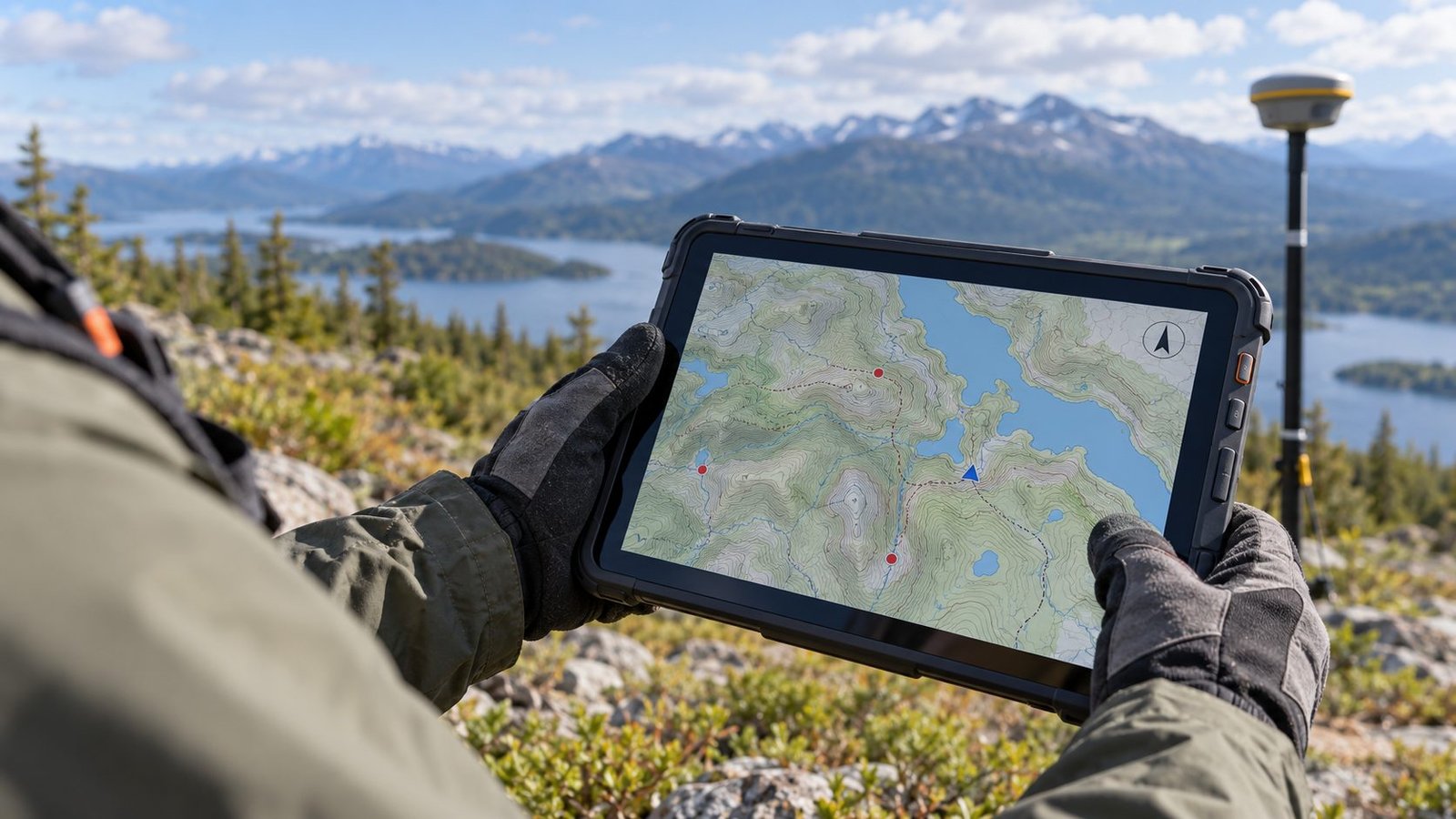
A tablet for GIS fieldwork has to do more than survive a wet day. It must let you read a map outdoors, carry an offline project, last through your shift, and work with the positioning equipment your project requires. For people using QField on a QGIS project or ArcGIS Field Maps, those practical details matter more than a long list of camera features.
Our two 10-inch-class picks take different approaches. The Samsung Galaxy Tab Active5 Pro is substantially lighter and has a brighter specified display. The Ulefone Armor Pad 3 Pro trades portability for a very large built-in battery. Both have Amazon.com product pages, though you should confirm the seller, exact configuration, and current availability before buying.
At a glance
| Field priority | Samsung Active5 Pro | Ulefone Armor Pad 3 Pro |
|---|---|---|
| Screen | 10.1 in; up to 600 nits | 10.36 in; 500 nits |
| Weight | 683 g (5G) | About 1,243 g |
| Battery | 10,100 mAh; replaceable | 33,280 mAh; built in |
| Best fit | Handheld field mapping | Long shifts with a mount |
Figures are manufacturer specifications for the named models. Battery capacity is not a measured runtime, and brightness specifications alone cannot tell you how readable either screen will be under your specific sun and glare conditions. A “10-inch” search commonly includes 10.1- and 10.36-inch screens.
Samsung Galaxy Tab Active5 Pro: the lighter field-carry choice
Samsung specifies a 10.1-inch display with brightness up to 600 nits, IP68 protection, a 10,100 mAh replaceable battery, and a weight of 683 g for the 5G version. The tablet supports touch with certain gloves; Samsung notes that performance depends on glove material and thickness. The 5G model in the linked Amazon listing is SM-X358UZGAN14, with 6 GB of RAM and 128 GB of storage. Check that model number if you need cellular service rather than a Wi-Fi-only configuration.
For a fieldworker walking between assets, the lower published weight is a persuasive advantage. The replaceable battery also gives a team an option to carry a compatible spare, though a spare battery and dock are separate purchases. Samsung lists GNSS support, but the tablet’s internal receiver should not be treated as a survey-grade positioning system.
Consider it if: You routinely hold the tablet, work around bright daylight, or need a managed team device with a replaceable battery.
Check before buying: Confirm cellular bands and carrier support for your area, spare-battery supply, accessory fit, and whether your particular QField or Field Maps workflow runs correctly on the device.

- RUGGED AND READY FOR WORK: Dust, dirt, sand and water won’t get in your way with the IP68 – rated¹ Galaxy Tab Active5 Pr…
- POWER FOR HOURS: Power through any project thanks to a long-lasting battery that won’t stop until your day does.⁴ When y…
- NEVER BE WITHOUT POWER: Easily change batteries on the go without powering down with Dual Hotswap (*when changing one ba…
Ulefone Armor Pad 3 Pro: the large-battery choice
Ulefone specifies a 10.36-inch, 500-nit display, a 33,280 mAh built-in battery, IP68/IP69K ratings, and a weight of about 1,243 g. Its Amazon.com listing names the Armor Pad 3 Pro and describes 4G LTE, Android 13, GPS, and a 256 GB storage configuration. The manufacturer describes 8 GB of physical RAM plus 8 GB of virtual RAM; a “16 GB RAM” listing should not be read as 16 GB of physical memory.
That battery capacity may appeal to crews that spend long periods away from outlets. The weight is the main tradeoff: it is roughly 560 g heavier than the specified Samsung 5G model before adding a mount or strap. Its published brightness is also lower. For a vehicle-mounted inspection or a long day at a fixed field station, those compromises may be acceptable; for hours of handheld mapping, try to handle a similar-weight device first.
Consider it if: Charging access is scarce and you can support the weight with a mount, stand, or harness.
Check before buying: The exact LTE bands and seller, Android update availability, how the device handles your offline project, and whether its 500-nit screen is readable at your work site. The Amazon listing includes some promotional specifications that differ from the manufacturer’s page, so use the manufacturer and exact model for your final check.

- 🔋【33280mAh Battery & 66W Fast Charging & OTG】The Ulefone Armor Pad 3 Pro Super robust 33280mAh capacity eases through a …
- 【Up to 16GB RAM+256GB ROM+Android 13】Features 8GB of RAM + 8GB Virtual RAM, plus 256GB of internal storage and 2TB expan…
- I【Dual 1100 Lumens Powerful Camping Light】The Armor Pad 3 Pro Tablet can be used as a multifunctional lightingtool that …
What matters for QField and ArcGIS Field Maps?
Sunlight and handling
Compare the listed brightness, but also look at screen reflections, viewing angle, glove response, and the way you will carry the tablet. For a crew walking all day, weight can outweigh a larger battery. An outdoor screen test under your actual conditions is more informative than a specification sheet.
Offline projects and storage
Prepare the map and forms before leaving coverage. Test the complete workflow: open the project, view every offline basemap layer, capture a feature with a photo, close and reopen the app, and synchronize when coverage returns. Storage needs depend on the project, imagery, and attachments. TechGeo’s QField introduction explains the mobile QGIS workflow. In ArcGIS Field Maps, also check your organization’s account permissions: installation alone does not grant data-editing rights.
GNSS accuracy
A rugged body or a list of GPS satellite systems does not imply centimeter-accurate coordinates. QField’s documentation says internal mobile GNSS typically offers around 5 m accuracy. For higher accuracy, QField can receive NMEA data from an external GNSS receiver over Bluetooth and other supported connections; an appropriate receiver and RTK corrections can provide centimeter-level positioning under suitable conditions. Test the receiver, corrections, coordinate reference system, antenna setup, and data capture together before relying on the result. QField specifies WGS 84 / EPSG:4326 output for external receivers.
App and carrier compatibility
Esri currently lists Android 10 or later, an ARMv7-or-later processor, and OpenGL ES 2.0 support for ArcGIS Field Maps. That minimum does not confirm that a specific combination of tablet, Bluetooth receiver, organization account, and project will work as intended. Ask the seller about regional cellular bands if mobile data matters, and run a pilot with your actual apps and equipment.
Which should you choose?
Choose the Samsung Galaxy Tab Active5 Pro if the device will be carried and used outdoors throughout the day: its published brightness and much lower weight suit that job. Choose the Ulefone Armor Pad 3 Pro if a large built-in battery matters more than handheld comfort. For a survey or asset inventory with tight coordinate tolerances, budget for and validate an external GNSS setup regardless of which tablet you buy.
The Oukitel RT7 is another 10.1-inch rugged model with a 32,000 mAh battery, but its identified Amazon.com listing was unavailable when this guide was researched. We have left it out of the buying table until a current listing and configuration can be confirmed.
Frequently asked questions
Can I run QField on a rugged Android tablet?
QField is an Android mobile GIS app. Check your chosen device’s current app-store compatibility, then test a copy of your own project, forms, basemaps, photos, and receiver before issuing tablets to a team.
Is a built-in GPS enough for surveying?
Usually not for work requiring sub-meter or centimeter accuracy. QField’s guidance puts typical internal mobile GNSS around 5 m. Specify your accuracy requirement first, then test a suitable external receiver and correction service with your entire workflow.
Does a 33,280 mAh battery mean three times the field runtime of a 10,100 mAh tablet?
No. Capacity ratings alone do not predict a precise runtime ratio. Screen brightness, network use, temperature, processor load, battery voltage, and connected accessories all affect how long a tablet lasts. Test a representative field shift.
Sources and review method
This guide compares published specifications and identified Amazon.com listings; TechGeo has not field-tested the tablets. Specifications: Samsung and Ulefone. GIS guidance: QField GNSS documentation and ArcGIS Field Maps requirements. Listings, configurations, and offers can change.