2 Funded Geospatial PhD & Postdoc Opportunities in Arabian Gulf – November 2026
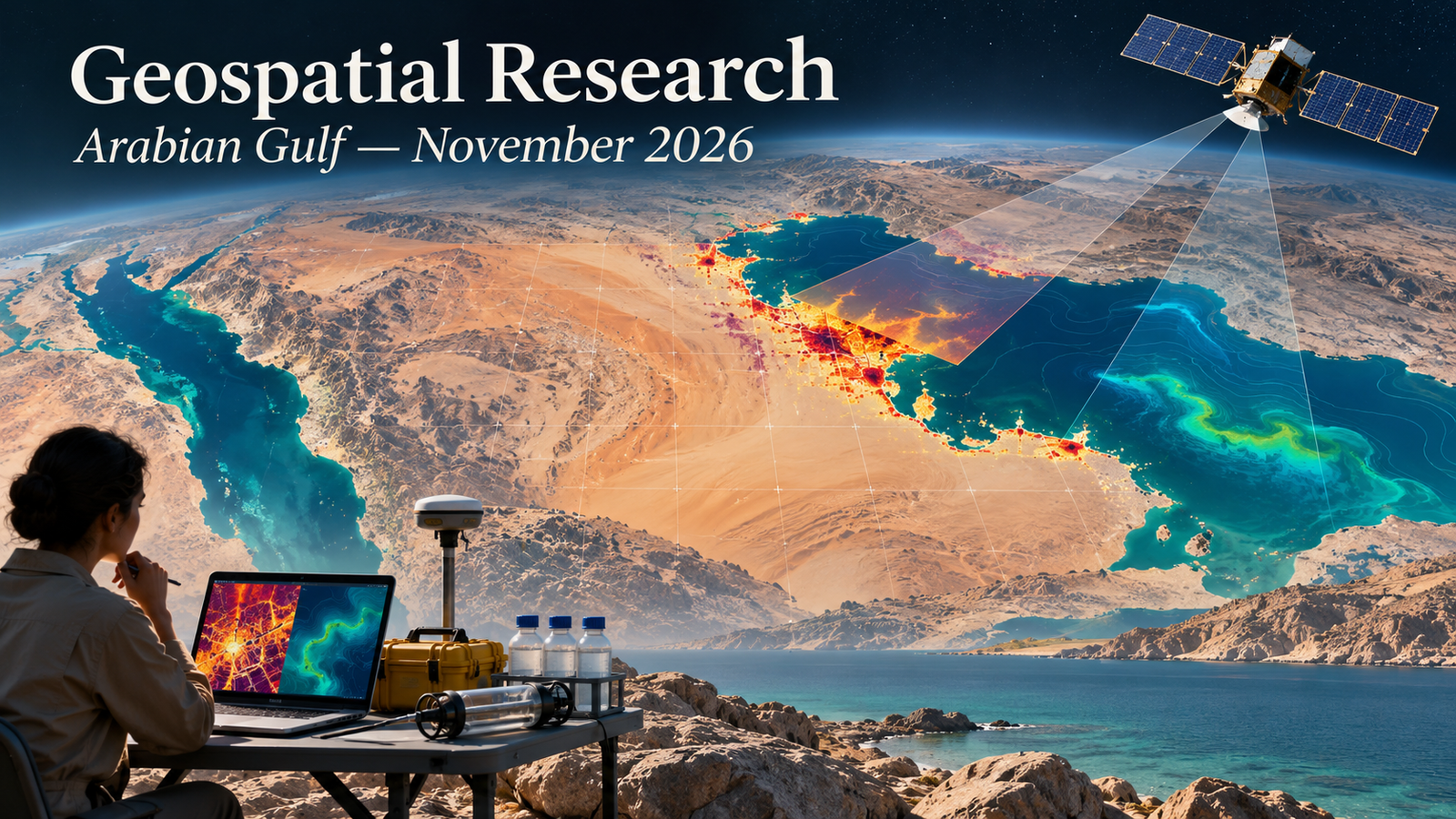
Verified on 23 November 2026. This edition of geospatial PhD and postdoc opportunities in Arabian Gulf November 2026 brings together two financially supported postdoctoral calls at universities in the United Arab Emirates and Saudi Arabia. The research themes span satellite-based urban environmental analysis and spatial and temporal modelling of marine food systems. One role directly targets remote-sensing specialists; the other suits environmental spatial-data scientists with strong quantitative research skills.
Both opportunities are hosted within the region, regardless of where an applicant currently lives. This edition contains two postdoctoral opportunities and no PhD calls: we did not verify a specific open, funded doctoral call that met the selection criteria. The funding descriptions below reflect the individual official adverts. Neither states a salary amount or appointment duration.
Research calls may change or close early. Each opportunity was accessible and officially marked open when checked on 23 November 2026. Both recruit until filled, so apply promptly and confirm the details on the institution’s application page before submitting.
Compare the two open research opportunities
“Not specified” means the official call does not provide that detail. A confirmed salary package establishes financial support; it does not establish a particular stipend, net income, visa entitlement or guaranteed appointment length.
| Country | Level | Topic | Institution | Location | Funding/salary | Deadline | Application |
|---|---|---|---|---|---|---|---|
| United Arab Emirates | Postdoctoral associate | Satellite remote sensing of urban heat and land subsidence | New York University Abu Dhabi — Mubadala ACCESS | Abu Dhabi | Competitive salary and benefits; amount: Not specified | Rolling recruitment — until filled | View Call & Apply |
| Saudi Arabia | Postdoctoral researcher | Spatial and temporal modelling of aquatic-food nutrients | KAUST — Integrated Reef Fisheries Lab | Thuwal | Salary and benefits package stated; amount: Not specified | Open until filled | View Call & Apply |
United Arab Emirates
1. Satellite remote sensing, urban heat and land subsidence — NYU Abu Dhabi
NYU Abu Dhabi’s Mubadala Arabian Center for Climate and Environmental Sciences is recruiting a postdoctoral associate to work with Rita Leal Sousa on urban environmental change in the United Arab Emirates. The project connects satellite observations of surface temperature, land cover and ground deformation with field measurements. It is a strong research fit for applicants who can process optical or thermal imagery, undertake SAR/InSAR analysis, and explain the uncertainty of mapped results. A relevant doctorate must be held by the appointment start date. The call also requires satellite-image and geospatial-data experience, reproducible quantitative analysis, scientific writing and willingness to collect field data. Google Earth Engine, ArcGIS, ERDAS IMAGINE, programming and GNSS validation experience appear among the preferred skills. The official advert confirms competitive salary and benefits, but gives no salary amount or appointment duration. Applications are accepted immediately and reviewed until the position is filled. Submit the requested materials through the precise Interfolio call.
Application documents: Cover letter, CV, degree transcript or highest-degree copy, research statement, and at least two reference contacts/recommendation letters, all as PDFs. Follow the portal’s exact requirements. Duration: Not specified. Fixed deadline: Not specified; recruitment is explicitly rolling. Citizenship or visa conditions: Not specified in the call.
Saudi Arabia
2. Spatio-temporal aquatic-food research — KAUST
The Integrated Reef Fisheries Lab at King Abdullah University of Science and Technology is recruiting a postdoctoral researcher to study how the nutritional contributions of aquatic foods vary across locations and through time. Led by Jessica Zamborain-Mason, the project combines global and regional datasets with a particular focus on the Red Sea. This is an environmental spatial-data opportunity: its central tasks involve analysing geographic and temporal variation, helping develop long-term monitoring, and connecting nutrient sampling and dietary surveys to future food-security scenarios. It does not advertise satellite-image processing as a core duty. Applicants need a completed or nearly completed relevant PhD, strong quantitative and programming skills, and experience managing complex datasets. Spatial and temporal modelling is desirable. The advert states a salary and benefits package but supplies no amount or contract duration. KAUST’s current official listing marks recruitment open until filled. Apply through the individual Interfolio call with a tailored explanation of your spatial-analysis contribution.
Application documents: CV, a cover letter of no more than two pages, contact details for at least two referees, and a relevant sample peer-reviewed publication. Duration: Not specified. Salary amount: Not specified. Language: The desirable-experience section welcomes Arabic-and-English fluency for stakeholder work. Citizenship or visa conditions: Not specified in the call.
Choose the research fit before preparing documents
For the NYU Abu Dhabi role, demonstrate a complete remote-sensing workflow rather than listing software alone. A concise example might explain the satellite data used, preprocessing decisions, validation measurements, uncertainty checks and the resulting scientific contribution. Choose examples from your actual work in thermal mapping, land-cover analysis or deformation monitoring. If your expertise covers only one sensor family, make that clear and explain how it connects to the advertised project.
For KAUST, frame your experience around analysis across space and time: managing heterogeneous environmental datasets, choosing defensible spatial or temporal models, communicating uncertainty, and connecting measurements to useful outcomes. A satellite-processing portfolio alone will not explain your fit with nutrient sampling, dietary surveys and food-security analysis. Use your cover letter to connect relevant methods to the project’s marine and nutritional questions, while identifying any domain knowledge you would need to develop.
Application advice for postdoctoral and PhD candidates
For postdoctoral applicants
Tailor the research statement or cover letter to the actual scientific tasks. State your individual contribution to publications, code, field campaigns and collaborative projects. For NYU Abu Dhabi, organise the requested PDFs and reference information before starting the portal application. For KAUST, respect the two-page cover-letter limit and choose the sample publication that best demonstrates your quantitative contribution. Ask referees early and follow the institution’s requested reference format.
Because salary amounts and durations are not specified, request those details during recruitment before making relocation or financial commitments. Ask how the appointment is funded, its expected length, any renewal conditions and the benefits applicable to your offer. Eligibility, immigration and dependent arrangements must be confirmed with the host; do not treat another university’s policy as transferable.
For prospective PhD researchers
These two calls are postdoctoral appointments, so they are not substitutes for doctoral admission or scholarships. Track specific funded doctoral projects and check the research topic, supervisor, application window, tuition coverage, stipend and funding period together. A general doctoral-program page or an invitation to contact a supervisor is insufficient evidence of a funded place. For examples of how specific calls are presented, compare TechGeo’s Canada research roundup and Asia research roundup; their earlier verification dates mean you must check current status before applying.
Questions applicants often ask
Are these opportunities funded?
Both official calls state a salary or salary-and-benefits package. The numerical salary and appointment duration are not specified. We have not estimated either.
Do both posts require remote-sensing expertise?
No. NYU Abu Dhabi explicitly seeks satellite remote-sensing and geospatial-analysis expertise. KAUST focuses on environmental spatial and temporal data, marine nutrient contributions and associated monitoring. Choose the role matching your research evidence.
What are the application deadlines?
Both calls are currently open until filled. Neither provides a fixed closing date in the verified official call. Rolling review can end before an applicant expects, so confirm status and submit a complete application promptly.
Keep the next step specific
Read the exact call, match your strongest research evidence to its questions, and prepare the stated documents. This small selection reflects verified opportunities rather than a complete inventory of every university in the region. Follow TechGeo Geo-News for subsequent regional research updates.