5 Funded Geospatial PhD & Postdoc Opportunities in Germany – November 2026
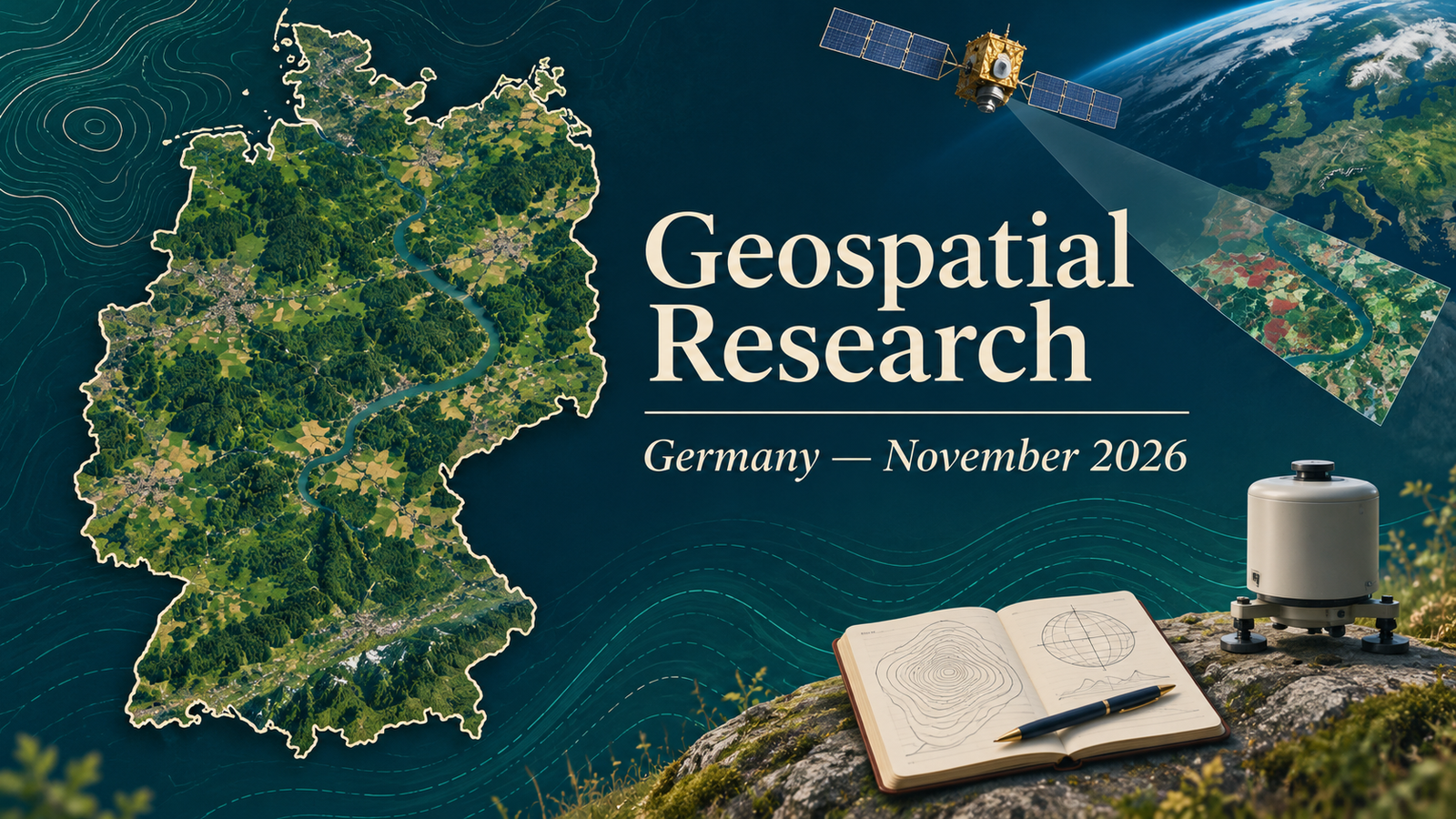
Geospatial PhD and postdoc opportunities in Germany November 2026: five specific salaried research calls passed verification on 14 November 2026. They comprise three doctoral opportunities and two postdoctoral appointments, hosted in Halle (Saale), Potsdam, Oberpfaffenhofen and Cologne.
The themes span land degradation, forest-carbon accounting, snow-mass gravimetry, GeoAI computer vision and GIS-based floodplain analysis. The region refers to the host’s location, not applicant nationality or the study area. All five calls expressly confirm remuneration; salary grades are reproduced without calculating individual cash pay.
Deadline priority: IAMO closes on 15 November. The two GFZ doctoral calls and Cologne postdoc close in December. DLR does not publish a deadline; its individual application control was active when checked. That is not a guarantee of continued recruitment or a claim that applications are explicitly rolling.
Research calls may change or close early. All included official calls were accessible and appeared open on 14 November 2026. Recheck the employer’s current instructions and application form before submitting.
Compare five funded research opportunities
| Country | Level | Topic | Institution | Location | Funding/salary | Deadline | Application |
|---|---|---|---|---|---|---|---|
| Germany | Postdoc | TransMoP: remote sensing and land degradation | Leibniz Institute of Agricultural Development in Transition Economies (IAMO) | Halle (Saale) | TV-L E13; full time; 3 years. Cash salary: Not specified. | 15 November 2026; closing time: Not specified | View Call & Apply |
| Germany | PhD / doctoral researcher | Forest-carbon attribution from Earth observation and atmospheric constraints | GFZ Helmholtz Centre for Geosciences | Potsdam | TVöD Bund E13; 75% appointment, 29.25 hours/week; 36 months. Cash salary: Not specified. | 2 December 2026 | View Call & Apply |
| Germany | PhD / doctoral researcher | SnowShifts: terrestrial and cryo-hydrological gravimetry | GFZ Helmholtz Centre for Geosciences | Potsdam; high-alpine and polar fieldwork | TVöD Bund E13; 75% appointment, 29.25 hours/week; 3 years. Cash salary: Not specified. | 4 December 2026 | View Call & Apply |
| Germany | PhD / doctorate | GeoAI and computer vision for transport-related image analysis | German Aerospace Center (DLR) | Oberpfaffenhofen | Federal public-service tariff remuneration; part time; 3 years. Grade, percentage and cash salary: Not specified. | Not specified; active individual application route checked on 14 November 2026 | View Call & Apply |
| Germany | Postdoc | GIS-based hydrological and habitat analysis in Rhine floodplains | University of Cologne — Institute of Zoology | Cologne | TV-L E13, subject to conditions; full time, 39.83 hours/week; 1 February 2027–31 January 2030. Cash salary: Not specified. | 4 December 2026 | View Call & Apply |
Research fit and verified conditions
1. TransMoP: remote sensing and land degradation — Leibniz Institute of Agricultural Development in Transition Economies (IAMO)
IAMO’s TransMoP postdoc will lead geospatial analysis of water stress, vegetation dynamics and land degradation in Uzbekistan and Kazakhstan. The employer is in Halle (Saale), so this belongs in the Germany edition despite the Central Asian study area. The three-year, full-time appointment is funded at TV-L E13, with an expected start in early 2027. Applicants need a relevant doctorate, strong Earth-observation time-series and spatial-analysis experience, and quantitative programming, preferably in R or Python. Landsat, Sentinel, MODIS and ERA5 are examples named in the call. The application requires more than a CV: it includes a two-page research proposal, referees, relevant certificates, the doctoral thesis and selected publications. Submit the specified documents to the application address in the official notice, using the requested subject line. Applications close on 15 November; no closing clock time is stated.
2. Forest-carbon attribution from Earth observation and atmospheric constraints — GFZ Helmholtz Centre for Geosciences
GFZ’s forest-carbon doctorate combines satellite observations, carbon-cycle models and atmospheric measurements to investigate management, disturbance and recovery effects on forest carbon exchange. The EUFOR-G3W project provides the research setting, including work with forest biomass, age and productivity information and the FLUXCOM-X framework. Applicants need a relevant MSc, quantitative analysis skills, Python experience with geospatial or large environmental datasets, and good English. Prior expertise across every contributing discipline is not expected. This is a 75% salaried appointment, currently 29.25 hours weekly, classified at TVöD Bund E13. The initial term is 36 months; an extension to four years is possible only subject to funding. The intended start is 1 February 2027 in Potsdam. Apply through GFZ’s online form by 2 December, supplying a CV with the requested three project-interest bullet points, certificates and grades.
3. SnowShifts: terrestrial and cryo-hydrological gravimetry — GFZ Helmholtz Centre for Geosciences
The SnowShifts doctorate at GFZ focuses on quantifying snow mass through superconducting gravimetry. The researcher will process temporal gravity observations, develop a processing toolbox and estimate changes in snow water equivalent. It is a geodesy-led project with links to cryospheric science and remote sensing, including cooperation on terrestrial and satellite gravimetry. Applicants need a relevant master’s, diploma or equivalent qualification, knowledge of gravity variations, time-series and statistics experience, and programming skills such as Python, MATLAB or FORTRAN. Willingness and ability to undertake high-alpine and polar fieldwork are explicit conditions. The Potsdam appointment is three years at 75%, currently 29.25 weekly hours, with TVöD Bund E13 classification. Its planned start is 1 February 2027. Apply online by 4 December with a CV, motivation letter and academic records; references are desirable if available.
4. GeoAI and computer vision for transport-related image analysis — German Aerospace Center (DLR)
DLR’s doctoral vacancy, reference 6902, develops AI methods for analysing transport-related imagery. The work includes assembling image datasets, training and evaluating models, and linking image-derived information with geodata to describe infrastructure and pedestrian flows. Street-level images, open webcams and remote-sensing inputs are examples in the official description. The role suits applicants with a completed relevant university qualification, Python programming and machine-learning knowledge, particularly computer vision or object detection. Good German and English are required. The employer confirms a three-year, part-time appointment paid under the applicable federal public-service agreements, but gives no grade, working percentage or cash salary. The individual advert retains an active “Jetzt bewerben” route at verification. No deadline or explicit rolling-recruitment promise is stated. Use that application route and confirm any unstated employment or doctoral-admission conditions directly with DLR.
5. GIS-based hydrological and habitat analysis in Rhine floodplains — University of Cologne — Institute of Zoology
The University of Cologne’s floodplain postdoc connects hydrological drivers with sediment, ecological and biogeochemical processes in the Rhine floodplain. The scientist will derive inundation and connectivity metrics, evaluate habitat availability and lead interdisciplinary synthesis, alongside project coordination and field campaigns. A relevant doctorate is required, together with R or Python hydrological analysis, GIS-based spatial analysis, and hydronumeric or habitat-suitability modelling experience. English communication at C1 equivalent is essential; some German is beneficial. This is a full-time appointment of 39.83 hours weekly, planned from 1 February 2027 to 31 January 2030. Remuneration follows TV-L E13 when the advertised personal and wage conditions are met. Apply through the university’s job portal using reference Wiss2611-01 by 4 December. The linked official flyer specifies the qualifications and application instructions, including submitting proof of qualifications without a photograph.
Preparing a doctoral application
Start with the scientific question, then connect it to evidence of your readiness to learn and investigate. A dissertation, field campaign or reproducible analysis can demonstrate useful skills. Explain your own contribution, the methods you used and a limitation you encountered. Avoid presenting an academic project as professional employment or claiming expertise across every topic in an interdisciplinary call.
Follow the exact document list and submission route. A supervisor enquiry is not a substitute for a formal application where a portal is required. Check whether a research-interest statement, motivation letter, certificates or transcripts are requested. Keep filenames clear, respect file limits and retain the submission confirmation. Ask the host about doctoral admission steps that are not specified in the vacancy.
Part-time employment percentages describe the advertised appointment. They do not establish how much of a doctoral project can be completed remotely or define a take-home salary. Confirm any unstated tuition, fieldwork or mobility costs with the host before relying on them. Citizenship eligibility, visa sponsorship and relocation support are Not specified in this roundup; no promise about them is inferred.
Preparing a postdoctoral application
Demonstrate an independent research contribution and a clear connection to the advertised tasks. Select publications or outputs that show the relevant question, methods, validation and findings. Explain what you led and how you worked with others. Where a proposal is requested, make the research design feasible and specific rather than writing a general statement about the importance of the subject.
For spatial and environmental research, a concise workflow can help a panel assess your reasoning. Describe the data, scale, uncertainty and checks that support a result. Explain how your analysis would connect with the other disciplines in the project. Use only material you are authorised to share, and provide accessible links or compact supporting files when the employer permits them.
Read the appointment’s duration, salary basis, language conditions and attendance requirements separately. An extension described as possible remains conditional. A tariff grade is not an individual cash offer, and flexible working does not imply permission to work from any country. Resolve a condition that materially affects your ability to accept the role with the recruiting institution.
Verification and useful preparation
Each included item links to a specific official vacancy or its official flyer. Funding or salary, level, host, location and application route were checked. The preceding 90 days of TechGeo academic coverage were compared by URL and title/host; no reused call was found. Expired opportunities, roles without a confirmed doctoral or postdoctoral level, and leads with insufficient geospatial fit were excluded.
For practice explaining technical decisions, use TechGeo’s GIS interview questions and answers. For another research edition, see the Spain PhD and postdoc roundup and France academic opportunities edition. Their calls have separate conditions and deadlines. Follow TechGeo Geo-News for further regional research updates.